
Corfu Guide: Top Tips for Your First (and Beyond) Trip
- Jan 10
- 35 min read
Those familiar only with the Aegean islands will see a completely different Greece in Corfu. Instead of white, cubic houses, there are colorful, magnificent villas, and the desert landscape gives way to lush, green pine forests.

Slender cypress trees reach toward the sky above hills where olive groves and vineyards intertwine to form an endless carpet of green. Corfu is a true paradise for nature lovers. Especially in spring, when the island is in full bloom, it's so pleasant to take a long walk or bike ride—breathing fresh air, listening to the birds, and feeling time slow down.
Corfu also gave me one of my most powerful experiences—its beaches. The variety seems endless: in the north, secluded bays with snow-white pebbles and cliffs; in the south, wide golden sands and soft dunes. And everywhere, the sea sparkles with every shade of blue—from delicate turquoise to deep azure. Every time I step out onto the water, I feel peace and gratitude for these moments of silence.
What to see in Corfu Town (Kerkyra)
The island's capital, Kerkyra, is a lively and cozy city with a population of just over 40,000. The heart of Corfu beats here: its economy, culture, and history. But what touched me most was the Old Town—narrow streets with a rustic charm, where every turn reveals something new. If you're in Corfu, be sure to spend at least one night in Kerkyra—to take a leisurely stroll in the evening, when there are fewer tourists, and experience the true rhythm of the island.
→ Our favorite accommodation in the Old Town is the Corfu Sky Loft Apartments. Cozy, with rooftop views, and close to everything important. View and book here: Corfu Sky Loft

The best time to experience the unique charm of Corfu's Old Town is early morning and evening, after the tourists and cruise ship passengers have departed, when you can leisurely stroll through the narrow, winding streets. You can also join a guided tour of the city through GetYourGuide*.

The Venetian influence is unmistakable in the architecture of Corfu Town (Kerkyra). The Venetians ruled the island for over 400 years, leaving their mark. Since 2007, Corfu's historic old town has been a UNESCO World Heritage Site.

Vlacherna Monastery and Mouse Island
Approximately 6 km south of the capital, in the Kanoni area, lies one of the island's most popular photo spots. The Vlacherna Monastery (Panagias Vlachernon) is mentioned in every tourist brochure and is worth a visit at any time of day. The 17th-century church gleams dazzlingly white on a cape jutting out into the sea, and the airport runway is located directly behind it.

A concrete pedestrian bridge leads to Vlaherna Monastery, and then you can take a small boat (kaiki) to the neighboring island of Pontikonisi (5 minutes by boat, 3 euros per person). The island is home to the Church of Sotiros, a kiosk, and a handicraft shop. Turtles and peacocks hide in the dense undergrowth of the island, also known as Mouse Island.

Mon Repos Park
The park at Mon Repos, the former summer residence of the British royal family, appears somewhat overgrown and neglected. Prince Philip (who died in 2021 at age 99), husband of the late Queen Elizabeth II (who died in 2022), was born on this estate. In 1994, the Greek state acquired the property and restored part of Mon Repos Palace.

While history buffs are drawn to the Mon Repos Palace and its royal museum, swimmers can cool off in the beautiful bay with a pier in the southeastern part of the complex.
Mon Repos Palace Hours: Wednesday-Monday, 9:00 AM - 4:00 PM, admission €4.
Achilleion of Corfu
The former summer residence of the Austrian Empress Elisabeth is one of the most important attractions on the island of Corfu and a pilgrimage site for countless admirers of Sisi.

The majestic Achilleion Palace, including its park and viewing terrace, is located south of the island's capital and is especially worth a visit early in the morning, before the countless tour buses arrive.
Sisi named her estate after the Greek mythological hero Achilles, whom she admired for his strength and beauty. Achilleion was built between 1889 and 1891 by the Italian architect Raffaele Caritto.

The various rooms of Villa Sisi, with their beautiful ceiling paintings, artwork and furniture, are worth seeing.

I especially enjoyed the Achilleion Garden of the Muses with its statue of the dying Achilles, as well as the terrace offering a magnificent view of Corfu's east coast. It's recommended to allow at least two hours to explore the grounds.
Achilleion Garden in Corfu: Opening hours: Daily from 8:00 AM to 9:00 PM; entrance fee: €9.
Achilleion Garden is closed! Due to extensive renovations, the interior of the Achilleion is closed until further notice; visiting is only possible in the garden.
Sights of the Corfu Mountains
A road trip around Corfu in a rental car is especially worthwhile, taking in the central mountain range around Mount Pantokrator, the island's highest peak (906 meters). Due to the poor condition of the roads and narrow, winding roads, it is extremely important to observe safe and careful driving practices.
A rural idyll in Sokraki
Far from the bustling tourist trails in northern Corfu, small mountain villages are hidden, where the island's true, authentic soul is still preserved. It was here, among the wooded slopes, that I experienced the peace I've so often dreamed of.

The best place to start is Ano Korakiani, a charming village through which we drove slowly, enjoying the views. Then the road led us up to Sokraki. Narrow, winding, with sharp turns, the car barely managed, and at one point we decided to leave it at the entrance and walk.
When we entered the village, it was absolutely quiet. We were the only visitors. Narrow alleys, old stone houses, potted flowers—everything exuded peace. Sokraki's main square is a true gem. And nearby is Vartsas's Café (Καφεπαντοπωλείον ο Βάρζας), where we simply stopped to sit. The owner, Dimitris, greeted us as warmly as if we were old friends. He inherited this coffee shop and small shop from his family and lovingly renovated it in 2019. On the top floor, he showed us the traditional furnishings of a Corfiot home—simple yet heartfelt details. We sipped cool coffee, looked out onto the square, and felt time stand still.
Stelios's workshop, Olive Wood Art Sokraki, is located in the eastern part of the village. He makes amazing olive wood items: dishes, jewelry, souvenirs—all handmade from local trunks and branches. The prices are very reasonable, and the quality is incredible. We couldn't resist buying a beautiful keepsake—it now hangs in my home, reminding me of the silence of Sokraki every time I visit.
Nymfes Waterfall
From Sokraki, our route continued through Zygos and Klimatia to the village of Nymfes. There, following the signs for "Katarpaktīs Nymfes," we turned onto a dirt road into a dense forest. We reached the parking lot, and then walked down a narrow path down the slope.

The descent is steep, but worth it. Below is a green valley teeming with life (though be prepared for mosquitoes!). The sound of water can be heard from far away. Even in July, when we visited, a thin but persistent trickle ran over the mossy rocks. In the spring, they say, there's a real waterfall here—powerful and majestic. And in the summer, it's quiet, almost meditative.
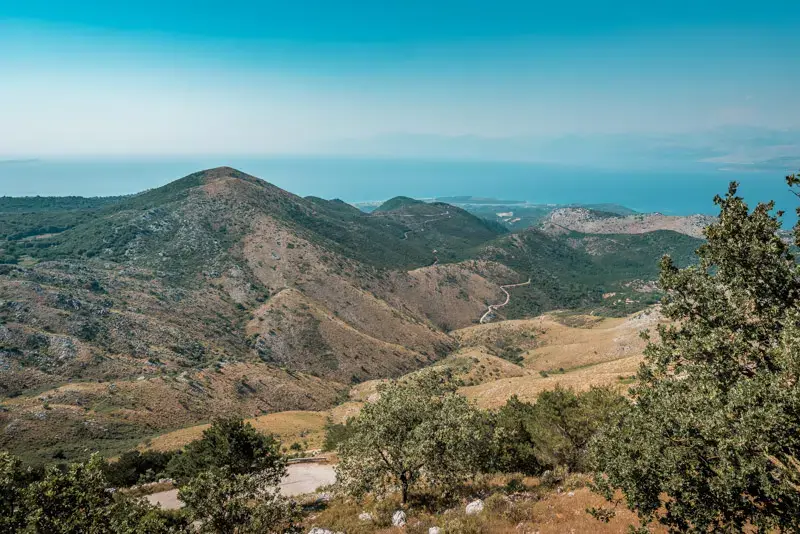
If the day is clear, from Nymphes you can continue through Episkepsis and Strinilas to Mount Pantokrator, the highest point in Corfu. From there, a panorama opens up across the entire island, the Albanian coastline, and the endless Ionian Sea. At such moments, you realize how small a person is and how vast the beauty of the world is.
These places in northern Corfu are for those who seek not souvenirs and "backdrop" photos, but a true connection with the island. Silence, simplicity, and the feeling that time flows differently here.

The road across the plateau is a real adventure: the surface is poor in places, the turns are sharp, and the car bounces on the bumps. If you're looking for something more relaxed, I recommend descending from Nymphes to the coast via Roda, and then returning towards Strinilas—the views are just as good, and your nerves are more relaxed.
The summit of Pantokrator itself, frankly, doesn't justify the long climb if you're expecting something spectacular. There are a few radio masts, a simple snack bar, and a rather modest monastery. The whole impression is from the panorama: the island spread out before you, the Albanian coastline in the distance, and the endless Ionian Sea. Parking at the top is limited—in high season, it's best to leave the car a little lower and climb up on foot.
On your way back, be sure to stop by the Oasis taverna in Strinilas. It's located in the village square under a huge old elm tree—shady, cool, and peaceful. The hosts are incredibly welcoming, and the food is generous and hearty. We especially loved the homemade moussaka—the layers tender and flavorful—and the eggplant saganaki: crispy crust, melting cheese inside. We sat there for a long time, unhurried, and it was one of those moments when you realize: this is the real Corfu.
Paleo Perithia
Almost all guidebooks now call Paleo Perithia the main attraction of the north—an "abandoned village in the mountains," with a "ghostly atmosphere." We also went with high expectations.

Unfortunately, my impressions were mixed. The village hasn't been abandoned in the sense one might imagine: at least five taverns operate in the main square, three of which literally compete for tourists. During peak season, over a hundred cars park in front of the entrance, completely destroying any sense of privacy. We didn't sense any "sinister" or mysterious atmosphere—more like the usual tourist bustle.
But if you walk further, to the southern outskirts, you'll still find that same charm of Old Perithia: silence, old stone houses overgrown with ivy, and almost no one around. It was there that we found a small paradise—the garden of beekeeper Vasilis. He sells his Corfiot honey right among the flowers and hives. We bought a couple of jars—fragrant, thick, with hints of local herbs. It became our only, but very warm, memory of Paleo Perithia.
If you're looking for true peace and authenticity, it's better to choose less popular villages like Sokraki or Nymphes. Perithia is only worth visiting if you're nearby and willing to venture further from the main square.
Places like these teach you one thing: sometimes the most powerful impressions aren't found in the places where everyone's taking photos, but in the quiet corners where few people venture.
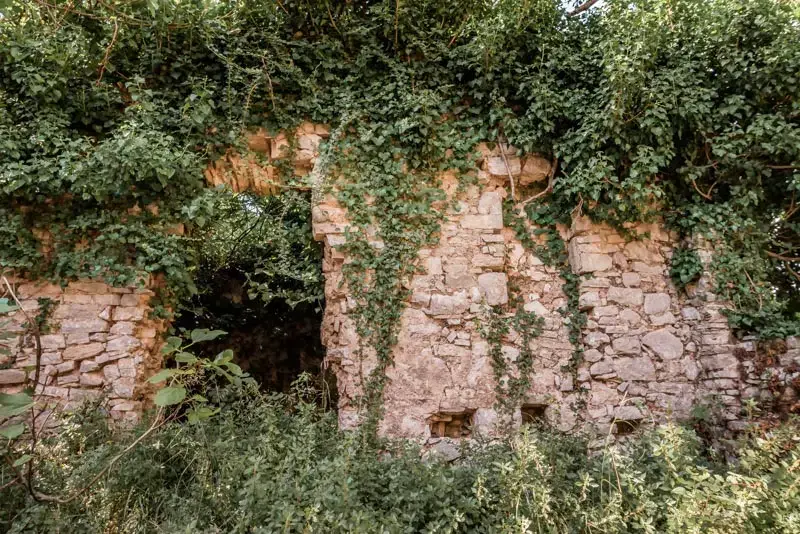
Old Synies – a true ghost village in Corfu
If, like me, you're looking for a place where time seems to stand still and want to experience the true silence of an abandoned village, then head to Old Synies (Palies Synies). It's at the foot of Mount Pantokrator, in the north of the island.
Unlike the popular Paleo Perithia, there are no tavernas, parking lots, or crowds of tourists here. Just old stone ruins of houses, overgrown with ivy and wild herbs, and complete isolation from civilization. You can get there either on foot along a trail (an hour and a half's leisurely walk from the nearest road), or by 4x4, if you're feeling adventurous.
When I got there, it was absolutely silent—only the wind in the olive trees and the distant sound of the sea. Not a soul in sight. This place touches you deeply: you imagine how people once lived here, raised children, harvested crops… And now, only echoes of the past and the feeling of being at one with the island's history.
If you love such quiet, almost mystical corners, Old Synies will not disappoint. Just bring comfortable shoes, water, and maybe mosquito repellent. And take your time—time flows differently here.
This is one of those places in Corfu that I mentally return to when I need peace and quiet. If you've been there or are planning to go, share your impressions in the comments; I'd love to see you there.
Kassiopi and Ermitis – the other side of northern Corfu
The north of the island was indeed the earliest to become a tourist destination – resorts for British guests developed here from the very beginning. Sidari, Roda, Acharavi, and neighboring villages are full of hotels, apartments, fish and chip bars, gyros kiosks, and souvenir shops. Corfu as a whole has miraculously avoided major architectural mistakes, but these coastal towns have lost some of their original charm – they've become too resort-like. The beaches here are beautiful, but I personally prefer the secluded bays and sandy expanses in other parts of the island. However, tastes differ – some prefer this lively atmosphere.

But if you turn slightly away from the main roads, the north reveals a completely different face. Two places that particularly touched me with their peace and beauty were Kassiopi and Cape Ermitis.
Kassiopi is a small fishing port with a truly Greek character. It doesn't have the crowds of Sidari, but it has a cozy harbor with colorful boats, a few tavernas by the water, and old streets where you just want to wander aimlessly. I loved sitting on the waterfront in the evening, watching the fishermen return with their catch and the sun sink into the sea. Nearby are several quiet pebble beaches, almost deserted. For me, Kassiopi is a balance: there's life, but without the bustle.
And Cape Ermitis offers complete peace and wild beauty. The road there is narrow and winding, leading through olive groves and cliffs. Below are hidden coves with white pebbles and incredibly colored water. We walked down a path to one of them—it was steep, but worth it. All around was the sound of waves and the cries of seagulls. I felt like I was at the end of the world: no hotels, no shops—just nature and a feeling of complete peace.
If northern Corfu isn't about bustling resorts for you, but rather quiet corners like these, then Kassiopi and Ermitis are definitely worth adding to your itinerary. There, the island reveals its true, unhurried soul.
Have you been to the north? Which places stood out to you more—the lively ones or the more secluded ones? Share your experiences in the comments; I'm always interested in reading your stories.
The Port Town of Kassiopi
In the northeast of Corfu, there's the small port town of Kassiopi, which, despite its popularity, has retained its authentic charm. There's none of the bustle of the larger resorts here—only the relaxed rhythm of Greek life by the sea.
Motorboats, yachts, and pleasure craft glide quietly along the curved pier. The waterfront comes alive in the late afternoon: fishermen mending their nets, locals strolling, and tourists occupying tables in cafes and tavernas. I loved sitting there with a coffee or a cold frappé—looking out over the harbor, listening to conversations, and feeling the day flow smoothly into evening. Everything was simple and heartwarming.

A hill topped with the ruined Venetian fortress of Kastro rises above the town. The climb isn't long, but the view from there is magical: all of Kassiopi is laid out in the palm of your hand, the harbor, the rooftops, and the sea stretching to the horizon. We strolled there among the old walls and shady olive trees—quiet, cool, and almost deserted. It's the perfect place to just stand and breathe.
Hidden just behind the fortress are two beautiful bays—Bataria and Kanoni. Light-colored pebbles, turquoise water, and cliffs along the edges—the beauty is incredible. On weekdays and outside of peak season, it's quiet; you can find your own little corner. But on weekends and in the height of summer, it gets crowded—locals come with their families, so the peace and quiet diminishes.
For me, Kassiopi is a balance: there's the life of the port, cafes, and promenades, but it still feels authentic. If you're looking for a place with soul, not a bustling resort, then stop here for at least a day. Or better yet, for an evening dinner by the water.

Ermitis Nature Reserve – Secluded Coves in Eastern Corfu
If you're looking for true peace and quiet, uncrowded swimming, I always head to the Ermitis Peninsula, east of Kassiopi. From Avlaki Beach, hiking trails lead – easy but picturesque – to small coves: Vrachli, Tsoufaka, Arias, and Akoli.
Everything here is just the way I love it: white pebbles and sand, turquoise, almost transparent water, cliffs, and silence. At times like these, it feels like the island is yours alone. You can simply lie on the rocks, listen to the waves, and feel the tension melt away.
Unfortunately, this corner of nature is no longer entirely wild. The former Ermitis Nature Reserve was sold to a private investor, and now a luxury resort is being planned there. The beaches are still accessible by land, but one can only wonder how much time we have left to enjoy them in their pristine state. I sincerely hope that at least some of this beauty will be preserved for everyone.

Koloura Port – a quiet haven on the east coast
If you drive south from Ermitis along the east coast, it's worth stopping at the small harbor of Koloura. There are no tourist crowds, souvenir shops, or bar music here – just peace and quiet.
Colorful fishing boats gently bob at the pier, the water reflects the sky, and the air smells of sea and salt. You can sit in one of the small tavernas or just on the rocks, grab a cool drink, and watch the day slowly pass. For me, Koloura is a place where you just want to be: without plans, without rushing, with the feeling that everything in the world is in its place.
Continuing west from Kassiopi along the north coast, you'll pass Acharavi, Roda, and Sidari – lively resorts that I usually bypass. But there are two things in this part of the island that are definitely worth seeing – I'll talk about them in future posts.

A Visit to Roda and the Corfu Soap Workshop
On the road from Roda to Sidari, right along the main road, stands a small but heartwarming workshop—Corfu Soap Workshop. Jonathan and his family run it, and every time I drive by, I smile and think, "I have to stop in."
The interior is a true paradise for those who love all things natural and authentic. They make handmade soaps according to ancient recipes, using island olive oil and local herbs. Rosemary, lavender, lemon, and mint—the scents are so fresh, you'd think they'd just been plucked from a tree. No preservatives, no chemicals—just pure ingredients and a passion for the craft.
There's soap for the body, hands, face, even hair—all gentle, natural, and free of unnecessary additives. We happily stocked up: we picked up a few bars for ourselves and souvenirs for the family. Now, when I wash my hands or shower, the scent of rosemary or lavender transports me back to Corfu—to that quiet day when we simply stopped by for soap and left with a feeling of happiness.
If you enjoy genuine, non-commercial places like this, check out Corfu Soap Workshop. It's not just a shop, it's a piece of authentic Corfu in a small workshop by the road.
Have you brought back any special souvenirs from Corfu? Share them in the comments—I'm always interested in reading your stories.

The Canal d'Amour – Legend and Reality of Northern Corfu
The Canal d'Amour is one of Corfu's most famous landmarks, and I really wanted to see it with my own eyes. It's not actually a single canal, but a group of narrow sea inlets cut deep into the golden-red sandstone cliffs. Over thousands of years, waves have carved amazing shapes: arches, grottoes, and isolated stone "islands." Legend has it that if you swim through these canals hand in hand, your love will last forever. Romantic, right?
But the reality is a little different. The entire coastal area around Sidari, including the Canal d'Amour, has long since become a popular resort. During high season, it's packed with tourists: umbrellas, sun loungers, music from bars, and souvenir shops. We arrived during the off-season, and that saved the day—there weren't many people, and I was able to stroll peacefully along the cliffs, peer into the coves, and listen to the waves crashing against the rocks. It's moments like these that make you realize why this place was once considered magical.
If the main Canal d'Amour seems too crowded, head further west to Cape Drastis. The viewpoints there are quieter and more relaxed. The rock formations are incredible: the waves have carved strange shapes, and the view of the sea and the horizon is simply mesmerizing. We stood there for a long time, the wind in our hair, and I felt like I was at the end of the world—in a good way.
The Canal d'Amour is a place worth seeing, but best in the off-season, early in the morning or towards sunset. Then it reveals its true, quiet beauty, free from the bustle and crowds.
Have you been there? What do you think of this place—romantic or a tourist trap? Let me know in the comments; I'm always interested in your impressions.

Cape Drastis – the romance and tranquility of northwest Corfu
The northwest part of the island is a place for those who love solitude and true beauty. Here, sandy beaches stretch for miles, and the coastal landscape is so romantic that every sunset feels like a gift.
We spent a whole week in Agios Stefanos, a small coastal town with long, golden beaches. And I still remember that time as one of the most peaceful and happy in Corfu. Morning coffee on the terrace overlooking the sea, afternoon strolls barefoot on the sand, and evenings of silence and sunset. I couldn't imagine a better place to relax.
The most powerful attraction here is Cape Drastis. It's an alternative to the Canal d'Amour, but far wilder and more impressive. The sandstone cliffs, carved by the waves into incredible shapes, look like they're from another world. It's best to visit the observation deck during the day, and definitely at sunset—when the sun paints everything gold and pink, and the shadows become long. We stood there for a long time, silently, simply gazing at this beauty.
Important to know: the cape itself is privately owned, so you can't walk all the way to the tip—there are discreet signs and fences. I advise respecting the boundaries and not risking conflict with the owners. It's best to stay on the platform and along the trail.
If you follow the gravel path down to the coast, you'll find a boat rental shop and a small, cozy swimming bay. The water here is clean, clear, and almost deserted—perfect for a quiet swim.

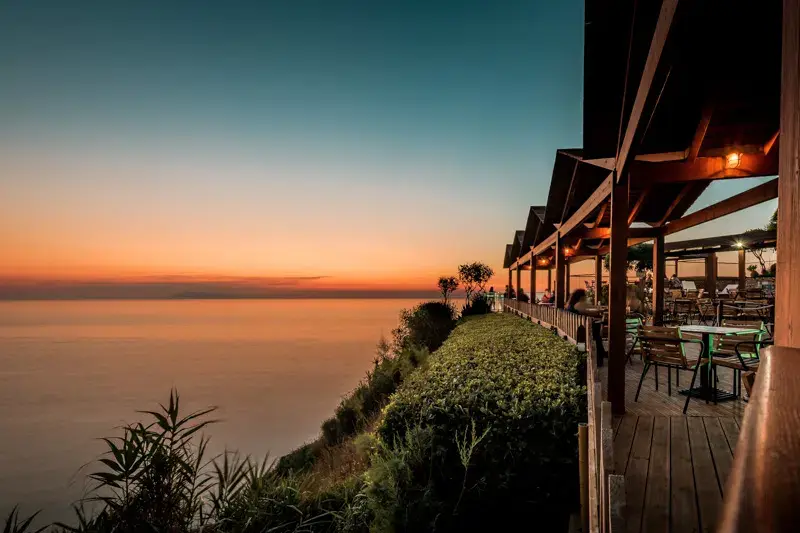
It's especially magical here in the evening. After Drastis, we always headed to the 7th Heaven bar on Loggas Beach—stylish, panoramic, and right above the cliffs. It's one of the most popular sunset spots in Corfu. The terrace juts out over the cliff, making it feel like you're hanging above the sea. The cocktails are delicious (around 11 euros), and the atmosphere is relaxed. To get a front-row seat, arrive a little early, especially in high season. We arrived half an hour before sunset, grabbed drinks, and simply waited for the sky to light up. These moments remain in your heart forever.
Cape Drastis and 7th Heaven are places you want to return to again and again. Here you understand why Corfu is called the island of love and peace.
Have you been to Drastis or 7th Heaven? Which sunset was most memorable? Tell us in the comments—your stories always warm my heart.
Porto Timoni Beach – Two Coves Worth Getting Up Early for
If you're looking for something special in Corfu, the two coves of Porto Timoni are the place everyone talks about with rapture. They're located next to the wide sandy beaches of Agios Stefanos and Agios Georgios, but they're completely different – small, secluded, with turquoise water and postcard-perfect cliffs.

To get there, it's best to leave early in the morning from the village of Afionas. You can reach the Porto Timoni restaurant by car, scooter, or quad bike—the road is narrow but quite passable. There's paid parking near the restaurant (5 euros per day), and from there, the hiking trail down to the bays begins.
Parking in the village itself is a real mess: the streets are tiny, and there's limited space. If you have a large car, it's best to park it a little further and walk—it's easier on both your nerves and your car.
Hiking to Porto Timoni
The descent takes about 25 minutes—the trail is steep and slippery in places, so comfortable, closed-toe shoes are essential. About 300 meters from the beach, there's a viewing platform offering a famous view of both bays: the cape, two lagoons, turquoise water, and green hills. This is the shot that later becomes your phone wallpaper.
Both bays are pebbly, with crystal-clear water. The water is incredibly clear, but even in July, it remained cool—almost icy. It gets crowded in the height of summer, so it's best to arrive between 8 and 11 a.m.—the beaches are still practically yours.
The beach has no amenities—no umbrellas, sun loungers, or cafes. Bring water (plenty!), snacks, a towel, and, please, a trash bag. This place is so clean and fragile—I want to leave it that way for others.
Porto Timoni is more than just a beach. It's a reward for rising early, for descending the trail, and for being willing to wake before dawn for the peace and beauty. As I stood there, listening to the waves and looking at the two lagoons, I felt: this is it—the Corfu I've been dreaming of.
Corfu Beer – the island's authentic beer
When I first tried Corfu Beer, I realized that everything I'd drunk before – Mythos, Fix, Alfa – wasn't the same. In Corfu, you order their beer, and after the first sip, you usually think, "That's it, I don't need anything else."
This small, family-run brewery does everything right. No compromises: the hops are imported from Germany, the malt from Thrace, and the water from the island's purest springs. Just these three ingredients create seven distinct varieties, each with its own character.
I especially loved:
Red Ale Special – rich, with caramel notes
Dark Ale – dark, deep, and cozy
Amorosa Weiss – light wheat, with aromas of banana and clove
EPOS – strong, with character
IPA – bright, hoppy
Ionian Pilsner – classic, fresh and cleanй

The beer isn't pasteurized or canned—it's live, so it only lasts a few months and should always be refrigerated. This makes it even more delicious and valuable—you drink it right here and now, while it's fresh.
The story began in 2006 with the first Pilsner. Today, Spiros and his team brew over a million liters a year—for Greece and for export to Germany, Italy, and England. In the summer, brewery tours and tastings are held in the village of Arillas—a true pleasure: seeing the process, tasting everything fresh, and listening to the owners' stories.
The highlight is the annual Corfu Beer Festival at the end of September. It brings together beer lovers from all over the island, music, food, laughter—and, of course, a sea of Corfu Beer.
For me, Corfu Beer is more than just a drink. It's the taste of the island: honest, fresh, made with soul. If you're ever in Corfu, be sure to find a bottle or a glass—and experience how beer becomes part of this quiet, true paradise.

Paleokastritsa – the pearl of northwestern Corfu
Paleokastritsa is the place I return to most often in my thoughts. The coastal landscape here is like something out of a postcard: high, pale cliffs, turquoise bays, green hills, and a sea that shimmers with every shade from delicate aquamarine to deep azure. For me, it's one of the most beautiful and soulful places on the island.
The best way to explore Paleokastritsa is not from the shore, but from the water—on an organized mini-cruise with barbecue. You'll sail along the cliffs, enter hidden grottoes where the water glows from within, stop in secluded coves for a swim, and then be served freshly prepared meat, vegetables, and local wine on deck. All around you is the sea, the cliffs, and the silence, broken only by the lapping of the waves and the conversations of those nearby.
This isn't just a tour—it's a whole day in the embrace of nature, where you can simply be, breathe, and feel time stand still.
If you're planning a trip and want to try this cruise, here's a verified link to GetYourGuide—it has all the details, prices, and availability:
I've been on this cruise several times, and each time I return with the feeling that Corfu has revealed something new to me. It's a place where you just want to be silent and watch.
Climbing Angelokastro – a panoramic view of Corfu from above
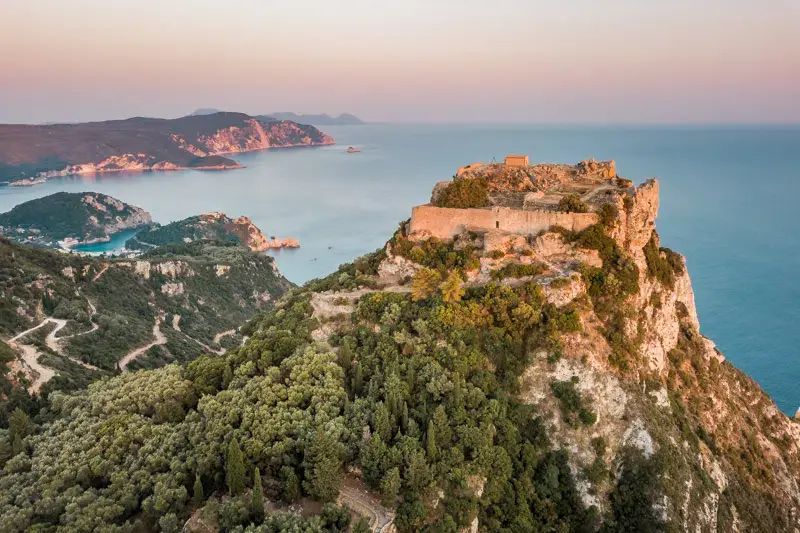
My first real encounter with Paleokastritsa began with Angelokastro. This 13th-century Byzantine fortress stands on a rocky outcrop, seemingly growing out of the stone—tiny castle ruins, almost merging with nature. The climb seems long and tiring, especially in the heat, but every step is worth it.
When you reach the top, your breath is taken away: the entire northwestern part of the island opens up before you. The sea below is endless, with dozens of shades of blue; motorboats and yachts appear as tiny dots, and the bays of Paleokastritsa seem like toy lagoons hidden among the rocks. At moments like these, you realize how beautiful Corfu is from above—and how little is needed for happiness: just stand, look, and breathe.
On the plateau of ruins, a cave church, a small chapel, and a cistern remain—all very modest but touching. Silence reigns there, broken only by the wind and the distant sound of the waves. I loved to sit by the wall, looking down, and thinking: this is the real Corfu—no fuss, no crowds, just stone, sky, and sea.
Opening Hours and Admission: Angelokastro is open Wednesday through Monday, 10:00 AM to 6:00 PM. Admission is €10; concessions are €5. Tip: come early in the morning or late in the afternoon—there are fewer people and the light is softer, perfect for photos.
If you're ready for the climb and want to see Corfu from above, Angelokastro is a place that stays in your heart. It teaches you that sometimes the most powerful impressions are those that require a little effort.

Paleokastritsa Monastery – the Quiet Heart of the West Coast
If you're on the west coast of Corfu, be sure to climb up to Paleokastritsa Monastery, or Moni Panagia Theotokou. It stands on a small peninsula right next to the village, and every time I go there, I feel a sense of calm deep within.
It's a beautiful monastery complex, inhabited by monks who care for it with genuine love. Bougainvillea blooms everywhere, in every shade of pink, purple, and red, cats stroll leisurely along the rocks, basking in the sun, and the air is filled with the scent of flowers, sea, and incense. It's always quiet here, even when visitors arrive—the place seems to guard its silence.
The garden behind the chapel offers one of the most beautiful views of the bays of Paleokastritsa: turquoise coves, cliffs, boats below—everything is in full view. I love standing there, looking down, and just breathing. It's especially magical early in the morning, when there are still few tourists—the sun is just rising, the light is soft, and it feels like the whole world belongs to you and these old walls.
Opening Hours: The monastery is open daily from 7:00 AM to 1:00 PM and from 3:00 PM to 8:00 PM. Admission is free, but donations are greatly appreciated—they help support the site.

And if you're looking for another little treat, west of the monastery, below the taverna, there's a walking path to a metal cross. It's a slight climb, but the view from the platform by the cross is stunning. From there, the bays are even more visible, and you feel like you're at the edge of the world—quiet, high up, with the wind in your hair.
For me, Paleokastritsa Monastery is more than just a landmark. It's a place where you can stop, be silent, and feel your soul at rest. If you're ever in Corfu, come here early in the morning. It's one of those moments that stays with you forever.
Corfu's West Coast – Peace and Beauty Between Glyfada and Paramonas
The west side of the island is my favorite. The narrow coastal road here winds through traditional villages, descends to wide sandy beaches, and passes small monasteries where time seems to stand still. It's a real challenge for drivers: steep climbs, sharp turns, sometimes even without guardrails. But every time you finally reach your destination, you feel such joy and relief – as if the island itself has rewarded you for your courage.
Mass tourism has left its mark on Glyfada – in July and August, it's crowded with people, umbrellas, and sun loungers. If, like me, you're looking for peace and quiet, it's best to visit in the off-season – May-June or September-October. Then the beaches are practically yours, the air is fresh, and the water is still warm.

This stretch of coastline offers several wonderful sandy beaches for a relaxing seaside holiday:
Glyfada is the most famous, with long, golden sand and a gently sloping entrance to the water, but it can get crowded during peak season.
Kontogialos (or Myrtiotissa) is one of my favorites: a cozy bay surrounded by cliffs, often nearly empty.
Agios Gordios is a wide beach with soft sand, beautiful cliff views, and unforgettable sunsets.
Gialiskari is small and quiet, but during our visit it was heavily overgrown with seaweed and looked a bit neglected—a shame, because the place is truly beautiful.
Parking at most beaches is a whole other story: chaos, narrow entrances, and limited spaces. It's better to take your time, park a little further away, and walk—it's even more pleasant, as the road winds through olive groves and blooming gardens.
For me, the west coast isn't about a "must-see" destination, but about the experience: here you can simply lie on the sand, listen to the waves, and feel everything within you calm down. Especially in the off-season, when there's no hustle and bustle—just you, the sea, and the island.
Myrtiotissa Monastery – Silence Above the Sea
After Paleokastritsa, our first stop was Myrtiotissa Monastery, one of the most secluded and beautiful places on Corfu. The 16th-century church stands perched high above the coast, and every day the sole monk who lives here gazes out at that same view: the endless sea, the cliffs, and the sky merging with the horizon. It's always quiet here—only the wind and the distant sound of the waves.
But there's one curious detail: if a monk looks down, he'll see Myrtiotissa Bay directly below him—one of the most picturesque on the island. This spot is still popular with nudists, and they feel quite free here. So the monastery and the beach coexist, each at their own pace.
To visit the monastery, it's important to follow simple rules: clothing must cover the shoulders and knees. If you don't want to walk down the steep and rather difficult path to the bay, just park at the top, near the Elia tavern – the view from there is stunning, and you won't have to go down.

Opening Hours: The monastery is open daily from 8:00 AM to 1:00 PM and from 5:00 PM to 8:00 PM. Admission is free, but donations are always welcome—they help maintain this sacred and beautiful place.
For me, Myrtiotissa is a place where you feel a sense of balance: on one hand, the spiritual silence and beauty of the monastery, on the other, the freedom and naturalness of the nature below. Here you just want to sit, look at the sea, and reflect on how everything in life can be simultaneously simple and profound.
The Kaiser's Throne—a panoramic view of Corfu from above
The Kaiser's Throne is one of those places in Corfu that I always return to with awe. It's located near the village of Pelekas, on a hill once a favorite spot for German Emperor Wilhelm II. They say he specifically chose this spot to look down on the island—and I understand why.
The climb is easy—from Pelekas, a road leads uphill. You can drive or walk (about 15-20 minutes at a leisurely pace). At the top, there's a simple observation deck with a stone "throne"—according to legend, this is where the emperor sat. From here, a fantastic panoramic view opens up over all of Corfu: green hills, olive groves, villages below, and beyond, the sea, ranging from turquoise to deep blue, and even the silhouette of Albania on the horizon.
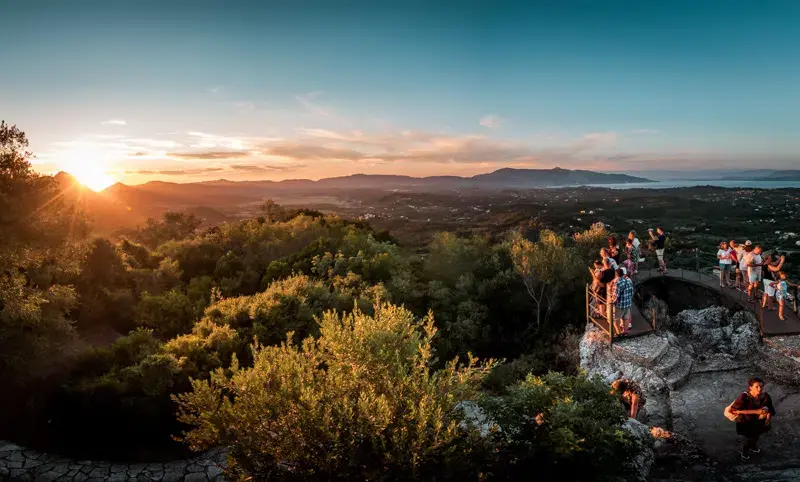
During the day, everything is bathed in bright light—you see every detail of the island, feeling its scale. But it's especially magical here in the evening, closer to sunset. The sky turns pink and orange, the sun slowly sinks into the sea, and the whole world becomes quiet and golden. I sat there, watching the light fade, and there was such peace inside—as if time had stopped just for me.
This place isn't about crowds and selfies (although there are plenty of tourists here). It's about the experience: rising just above the hustle and bustle, looking down on the world from above, and realizing how beautiful and fragile everything around you is.
If you're in Corfu, come here for sunset. Bring water, a light snack, and just be there. The Kaiser's Throne isn't just a viewing platform. It's a moment when the island itself tells you its story.
Agios Gordios Beach – Wild Beauty and a Quiet Place
Agios Gordios is one of my favorite beaches on the west coast of Corfu. Long, wide, with soft golden sand and a gentle slope into the water, it feels free and peaceful, especially if you wander away from the central area.
Beyond the Black Rocks bar, a completely different world begins. There, right by the shore, lies an old shipwreck – or rather, what's left of it. The violent winter storms of 2020/21 severely damaged it: now only fragments of the hull are visible, sticking out of the water, covered in seaweed and shells. This place has a slightly mysterious and melancholy feel – a reminder of nature taking its toll.

Further on, a wild, almost untouched stretch of beach begins—there are practically no sun loungers, umbrellas, or crowds here. You can swim peacefully, stroll barefoot on the sand, listen to the waves, and feel the island embrace you. In the off-season or early in the morning, there's hardly anyone here at all—just you, the sea, and the wind.
Agios Gordios isn't about a noisy vacation. It's about moments when you can simply be: looking at the wreckage of a ship that once sailed, now part of the landscape, and realizing that everything in this world changes, but beauty remains.
If you're looking for a place in Corfu where you can escape the hustle and bustle and simply listen to the sea, Agios Gordios, especially its wilder part, awaits you.
A Stroll Along the Coast and Viewpoints of Agios Gordios
Even though Agios Gordios beach can be busy in season, a stroll along its jagged coastline is always worth it. The cliffs, small coves, and sound of the waves create a feeling of being at one with the island, especially if you venture further from the central part.
Tucked away above the village of Aspes is one of my favorite viewpoints, Aerostato. The climb is easy, but the view from there is fantastic: all of Agios Gordios below, the sandy beach, the turquoise sea, and the hills receding into the mist. We came here at sunset—the sun slowly sinks behind the cliffs, the sky turns pink and gold, and below, silence, only the whisper of the waves. This is a place where you just want to sit and be silent, soaking in all the beauty.
Not far from Agios Gordios, the traditional villages of Kouramades and Sinarades are worth a visit. Narrow streets, old stone houses covered in flowers, small squares with churches and tavernas—real Corfiot life still lives here. There's no hustle and bustle, no tourist shops—just locals leisurely sipping coffee, children playing in the streets, and the air filled with the scent of olive oil and fresh bread.
Kouramades is especially cozy: the village seems frozen in time, with small courtyards and balconies where herbs dry. In Sinarades, you can wander the old alleys and feel how the island breathes not only the sea but also its history.

These places are a reminder: Corfu isn't just about beaches and views, but also about the people who have lived here for centuries, preserving traditions in simplicity and tranquility.
If you enjoy leisurely strolls like these, be sure to check out Kouramades and Sinarades.
Agios Nikolaos Beach – My Secret Corner in Corfu
One of my favorite and quietest beaches, the one I return to again and again, is the small Agios Nikolaos beach just beyond the village of Paramonas. It's hidden near the chapel of Agios Nikolaos, and to get there you need to walk a bit – it's like a little adventure that's worth it.

From Paramonas, a dirt road leads through a vineyard, then turns into a narrow footpath down to the sea. The descent is easy, but comfortable shoes are recommended, as it's rocky in places. As you descend, a snow-white chapel greets you below against the backdrop of the turquoise sea—and you immediately know: this is the place.
The beach is sandy, clean, with crystal-clear, warm water. The former harbor has silted up a bit, so the first meters into the sea are fine sand mixed with mud, but the water is still stunning. There are almost never any crowds here: in the off-season and even in the summer, early in the morning or afternoon, you can feel like you're the only person on the beach.
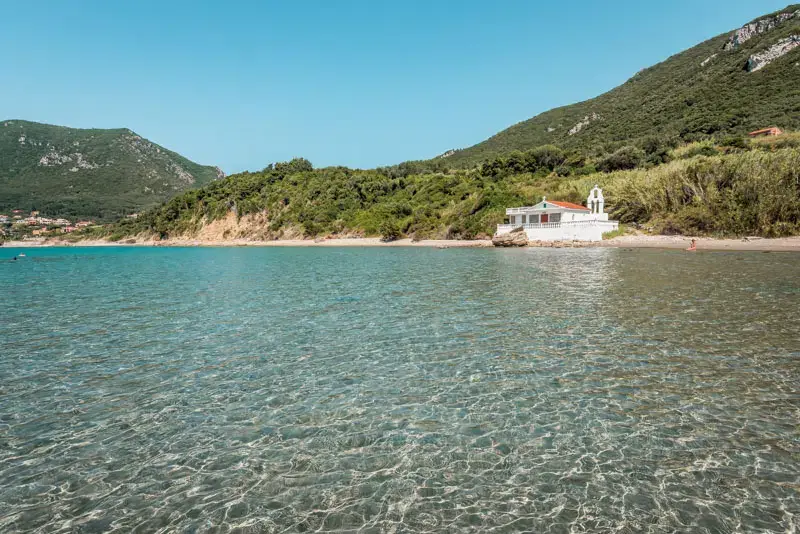
There's practically no shade, so be sure to bring an umbrella, water, snacks, and something comfortable to relax. This is a place for those who just want to lie down, listen to the waves, and take their time.
After a swim, I always recommend stopping by the Stribodikeio taverna in the village of Kalafathiones (not far from here). It's a true Corfiot taverna with a soul: a cozy courtyard rarely frequented by tourists, only by locals and those who appreciate good food. The owner speaks only Greek, but the menu is in English—and it has everything you need: homemade meze, fresh fish, local vegetables, and wine. Everything is prepared with love, the portions are generous, and the atmosphere is like being invited into someone's home.
Agios Nikolaos and Stribodikeio are, for me, two little wonders of Corfu: peace by the sea and a taste of true Greek life.
If you also love such secluded places, you mustно загляните.

Lake Korission – the quiet southwest of Corfu
Most visitors to Corfu flock to the north and center of the island, leaving the south often overlooked – too remote, too wild. But it was here, in the southwest, that I found the tranquility I so love. The Korission Lagoon Nature Reserve is a vast lake connected to the sea, created by the Venetians. It stretches for over 10 kilometers and is today an important site for migratory birds. Here you can hear flamingos, herons, and ducks – especially at dawn or dusk, when the air is filled with their cries.

Walking around the lake is one of the most meditative experiences in Corfu. The route takes 4-5 hours at a leisurely pace. The trail isn't always clear: in places, you'll walk over rocks, tree roots, and sand. But it's precisely this "wilderness" that makes the walk so special—you feel like a part of nature, not just a tourist. The best time is evening, when the sun sets over the horizon, painting the water gold and pink, and the birds are getting ready for bed. At such moments, you understand why people come here for the peace and quiet.

Just beyond the Korission marshes begin the famous sand dunes of Issos Beach and the long, almost kilometer-long sandy beach of Halikounas. These are two of the most open swimming spots in all of Corfu—even in high season, you can find your own little spot here. The sand is soft, the water is warm and clean, and the waves are moderate. I loved coming here after a walk by the lake—washing the dust off my feet, lying on the sand, and looking up at the sky. No umbrellas, no crowds—just you, the sea, and the wind.
South Corfu teaches one thing: sometimes the most beautiful places are those you have to walk, hike, and get tired to get to. But when you get there, you feel like it was all worth it.
Chlomos and Boukari/
The picturesque mountain village of Chlomos in the southeast of the island deserves special attention. Its winding streets and ancient buildings beckon for a short stroll. In the northern part of the village, near the Balish tavern, there is a magnificent view of the east coast.

From Chlomos, it's worth taking a short trip to the coastal village of Boukari. Numerous fish tavernas have opened here. Although Boukari doesn't have a proper beach, the atmosphere, with its caïques (traditional fishing boats) and docks, is very idyllic.

Notos Beach
Compared to the southwestern part, the eastern part of the island, with its narrow pebble beaches, didn't impress us much. However, not far from Notos Beach, we discovered a true gem—a beautiful bay for swimming. The botanical garden at the Panorama tavern was the absolute highlight of our stay in Corfu.

Nestled among banana plantations and tropical vegetation, this spot will instantly give you the feeling of being in the jungle. You can cool off in the crystal-clear waters by the dock. The tavern also provides sun loungers. Just be sure to bring mosquito repellent; mosquitoes thrive in such lush vegetation.
Visit to Mavroudis Olive Oil
It was the Venetians who, in the 16th century, promoted the development of olive farming in Corfu and cultivated olive trees on a large scale. Thus, Corfu maintains a centuries-old tradition and is home to olive trees that are up to 500 years old. Most of them are still family-owned.

For an interesting insight into the history of olive oil in Corfu and its production, visit the Mavroudis family near Chlomatiana. The family has been producing olive oil for three generations and owns over 2,500 trees, most of which are still hand-harvested.
A fascinating tour of the olive oil museum and production facility, followed by a tasting of selected varieties, is complimentary. Mavroudis extra virgin olive oil is simply superb, with its exceptionally fresh and fruity flavor.

We also particularly enjoyed the exquisite olive oils infused with herbs and spices, such as basil, garlic, and chili pepper. We stocked up on several jars of olive oil; the prices for 3 liters of extra virgin olive oil from Corfu, among others, were quite reasonable.
Mavroudis Olive Oil Shop Hours: Daily 8:00 AM - 8:00 PM.
Day Trip to Paxos
With Caribbean-like bays, picturesque villages, and countless olive groves, the two neighboring islands of Paxos and Antipaxos in southern Corfu are a true tourist attraction in their own right.
To get a first glimpse of the two small Ionian islands, I chose a boat trip to Paxos and Antipaxos. Day trips to Paxos depart from either Corfu Town or the port of Lefkimmi in southern Corfu.

Our first stop is the impressive sea caves of Ypapanti, followed by the Blue Caves on the west coast of Paxos. Depending on the light, the sea here shimmers with a magical blue. Unfortunately, almost all the numerous excursion boats enter the caves, so the beautiful scenery is somewhat spoiled by the musty diesel exhaust.
Our second stop is the Caribbean-like bays of Antipaxos, the most famous of which is Voutomi Beach. The turquoise water here is simply stunning, and you'd be tempted to dive right in, were it not for the hundreds of other boats that completely fill this idyllic bay during peak season. As a result, this paradise for swimming feels more like a giant, overcrowded children's pool.

The third and final stop on the day trip is either the main town of Gaios or the coastal village of Lakki on the island of Paxos, depending on your choice. We chose the charming port town of Gaios. You can take a lovely stroll along the waterfront, and the narrow streets and pastel-colored houses will make you want to grab your camera again and again.

When the numerous excursion boats arrive, the pier is usually bustling with activity. A little away from the crowds, you can relax at the Il Capriccio creperie. The friendly staff serves delicious savory and sweet crepes, waffles, pancakes, and ice cream. We would have happily stayed longer, but after two hours, it was time to return to Corfu. If you need a tour, you can book it directly through GetYourGuide*.
My conclusion about a day trip to Paxos
This boat trip is worthwhile if you want to get a first glimpse of Paxos and Antipaxos and take this excursion during the quieter off-season. Unfortunately, especially in July and August, you'll encounter overcrowded boats. In this case, the tour feels like a mass event. Alternatively, you can also visit the mainland villages of Parga and Sivota by boat. More information can be found on GetYourGuide*:
Alternatively, you can plan one or two nights in Paxos and take the regular passenger ferry from Corfu, operated by Kamelia Lines.
More tips for your Corfu vacation.
Excellent guided tours in Corfu.
Corfu offers a variety of excursions and activities that will allow you to get to know the island better. Below, we've selected some popular, highly rated activities in Corfu. For more information, visit GetYourGuide*:
Accommodation on Corfu Island
Corfu, one of Greece's most popular islands, offers a wide range of accommodation options to suit every taste and budget. Both independent travelers and package tours will find something to suit their tastes. The main tourist centers are located around Corfu Town near Gouvia, as well as in Benitses and in the north, near Sidari.
→ You can find a variety of accommodation options in Corfu through Booking.com* and check prices right here:
I spent the night in Corfu here.
Corfu Sky Loft, Corfu Town
High above the rooftops of the historic Old Town sit the tastefully furnished Corfu Sky Loft apartments. The charming owner, Vasilis, has created true gems, bringing together five apartments offering breathtaking views of the Old Town.
This two-story apartment was very modern, with a well-equipped kitchenette and air conditioning. We could enjoy the capital's evening atmosphere from the huge panoramic window. Overall, a wonderful place to stay in Corfu Town! You can find out more and book directly on Booking.com*.

Delfino Blu Boutique Hotel - Agios Stefanos (Avliotes)
This popular 4-star hotel in Corfu boasts a stunning seafront location and caters to every need of a family holiday in Corfu. This luxurious complex is surrounded by beautiful landscaping and is perfectly maintained. Guests can enjoy a swimming pool with a bar, a relaxation area, a spa, a fitness center, and a beach restaurant.

Owner Kostas's wonderful team anticipates your every need and, with a family-like atmosphere, ensures a relaxing and unforgettable stay. The breakfast buffet is so varied that everyone will find something to suit their taste. I was amazed by the variety of dishes every day!

The rooms are comfortable and tastefully furnished. Sleeping on the king-size bed was like sleeping on a cloud. Every evening, we enjoyed a fantastic sunset from our balcony overlooking the sea. This definitely won't be our last visit to the Delfino Hotel! You can learn more about the hotel on Booking.com*:
Which hotel in Corfu is right for me? I've prepared a review of the island's best hotels in a separate article: Best Hotels in Corfu.
Lianelia Boutique Village House – Argyrades
For our island tours in southern Corfu, a small country house in the lively village of Argyrades was the perfect base. Owner Konstantinos has lovingly restored the family estate, creating an exquisite two-story villa in Corfu, perfect for solo travelers and couples who want to explore Corfu on their own and prefer a more independent lifestyle.

The kitchen is well-equipped, and the holiday home has air conditioning, making sleeping comfortable even in the attic. There's a narrow alley in front of the house where you can enjoy breakfast in the morning.
Since the house is located in the very center of town, the nearby main road can sometimes be heavy during the day. This makes this accommodation especially suitable if you plan to spend a lot of time outdoors and have several excursions planned in Corfu. You can book the holiday home directly on Booking.com*:
Pine Forest House Villa - Kombitsi
Looking for a large holiday home in Corfu for the whole family (up to 8 people) in a quiet location on the edge of the forest with its own organic garden, hammock, and ample play space? Then Pine Forest House might be the perfect option. We spent six days here exploring central Corfu. We would love to stay longer in this idyllic place. More information on Booking.com*:

Restaurant Recommendations in Corfu
Gyros, pizza, pasta, French fries, and the like can be found on every corner in Corfu. Countless restaurants and tavernas have adapted to the tastes of tourists, so unfortunately, traditional Greek-Corfiot cuisine is often difficult to find. We spent four weeks exploring the island's culinary highlights, and below we'll share a small selection of our favorite restaurants in Corfu:
Oasis Taverna in Strinilias
Tsipouradiko in Corfu Town
Stribodikeo, in Kalafationes
Akrotiri Cafe, in Ag. Stefanos
Romantic Dinner in Corfu
Ambelonas Winery and Restaurant Vasiliki Karounou is located 8 km from Corfu Town, on a hill among vineyards. This idyllic estate offers breathtaking views of the valley. The entire Vasiliki team is incredibly passionate about what they do, and we couldn't have found a more romantic place in Corfu for dinner for two.

In the nearby historic courtyard buildings, you can purchase handcrafted products and learn about wine and olive oil production in pre-industrial times. Ambelonas is part of the Slow Food movement and specializes in local organic produce.
Getting Around Corfu
The island of Corfu, with an area of 585 km², stretches approximately 60 km from north to south and a maximum of 30 km from east to west. If you plan to explore most of the island during your vacation, having your own car is recommended.
Due to the long distances, a small car is preferable to an ATV or scooter, as the latter are better suited for short trips and require a powerful engine due to the steep climbs. On the Billiger-Mietwagen* portal, you can find affordable car rental deals in Corfu and check prices directly:
Отправить отзыв
Боковые панели
История
Сохраненные
The bus network on Corfu is also well developed, but getting from point A to point B takes a considerable amount of time. For short trips, especially from the capital, a bus in Corfu is a good alternative to a rental car. For longer distances, public buses are less suitable during vacations.
Corfu has a city bus, the Corfu City Bus, serving the city and surrounding areas, as well as intercity buses, the Corfu Green Buses, connecting the capital with the north and south of the island. Schedules for both routes can be found here:
Corfu Intercity Bus Schedule: Bus ScheduleGreen Buses
Corfu City Bus Schedule : Corfu City Bus Schedule
Arriving in Corfu
During the April-October season, Corfu Island offers direct flights from numerous German airports, including Condor, Ryanair, easyJet, Eurowings, and Aegean. Corfu Ioannis Kapodistrias Airport (CFU) is located 4 km south of Corfu Town.
At the airport, you can use taxi services for transfers from the airport to your hotel. You can also book a transfer from Corfu Airport to your hotel before arrival (bookings are available on GetYourGuide* ).
*Support my blog, Aegean Notebooks
This post contains affiliate links. If you click them and book or purchase, I receive a small commission, and the price for you remains the same. This helps me continue sharing my notes for free.
If you enjoyed this and want to leave a small, warm mark, you can treat me to a cup of Greek coffee ☕️ [Link] [to the coffee fund]


Comments